|
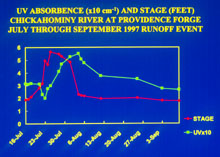 Changes
in UV 254 and stage during a storm-flow period Changes
in UV 254 and stage during a storm-flow period
| Project |
|
Title
Effects of Hydrology and Season on
Concentration and Speciation of Organic Carbon in Raw Water
Supplies for the City of Newport News
Number
VA104
Location
Chickahominy River Watershed
Cooperating Agencies
City
of Newport News
Project Chief
Gary Speiran
Period of Project
April 1995 through September 1999
|
|
|
|
Effects
of Hydrology and Season on Concentration and Speciation of Organic Carbon in
Raw Water Supplies for the City of Newport News

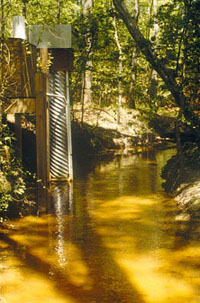
"Tea color" from organic carbon in a
tributary of the Chickahominy River
|
Problem
Certain
organic compounds in natural waters form trihalomethanes (THM's), haloacetic
acids (HAA's), and total halogenated organic compounds (TOX's) when the waters
are disinfected with chlorine or other oxidants for public supplies.
Organic compounds that form these disinfection by products (DBP's) must
be removed when concentrations exceed certain levels because the DBP's are
suspected carcinogenic compounds for which the U.S. Environmental Protection
Agency has established maximum contaminant levels (MCL's) for drinking water.
Humic and fulvic acids (high molecular weight, aromatic, organic
compounds) have been identified as THM precursors and other compounds can
contribute to the formations of other DBP's.
DBP precursors (organic materials that can form DBP's)
are abundant in wetlands environments and the water that discharges from these
environments. Therefore, DBP's are
a concern for public water supplies that use water that has flowed through
wetlands.
Raw water for public supply for the City of Newport News is primarily provided
by the Chickahominy River and Diascund Creek Watersheds.
The city is evaluating the Mattaponi and Pamunkey Rivers as possible
additional sources of water. These
watersheds drain extensive wetlands that have a variety of vegetation and water
regimes. Knowledge of the effects
that wetland environments, seasons, and hydrology have on concentrations of
dissolved organic carbon (DOC) and DBP precursors in these watersheds can be
used by the City of Newport News to select times for withdrawing and storing raw
water having low concentrations of DOC and DBP precursors.
Selective withdrawal can help reduce the cost of treatment to remove DBP
precursors. This knowlege can also
help in evaluating other watersheds as potential future water sources.
Objective
The
objective of this project was to identify relations of hydrology and seasons to
concentrations of DOC and DBP precursors in waters of the Chickahominy River and
Diascund Creek Reservoir Watersheds that were derived from different wetland
environments.
Relevance and Benefits
Results
of this study improve the understanding of the transport of DOC and DBP
precursors through the Chickahominy River and similar watersheds.
This understanding helps the City of Newport News manage the
withdrawal of water from the Chickahominy River in a manner to provide a public
water supply that meets the drinking-water standards for DBPs at a minimum of
cost. Results will also help
evaluate other watersheds as potential water sources.
Approach
This
investigation related the formation potential for THM's, HAA's, and TOX's
(indicators of DBP precursors), the absorbance of UV light at 254 (an indicator of concentrations of aromatic compounds that commonly
form THM's), and DOC concentrations to wetlands
environments, seasons, and hydrology during baseflow and stormwater flows at
selected sites in the Chickahominy River, Diascund Creek Reservoir, Mattaponi
River, and Pamunkey River Watersheds. The
amount of DOC and DBP precursors produced by organic detritus in the streams was
evaluated. The contribution of
DOC and BDP precursors to stormwater flow and baseflow through different
hydrologic pathways were also evaluated.
|